
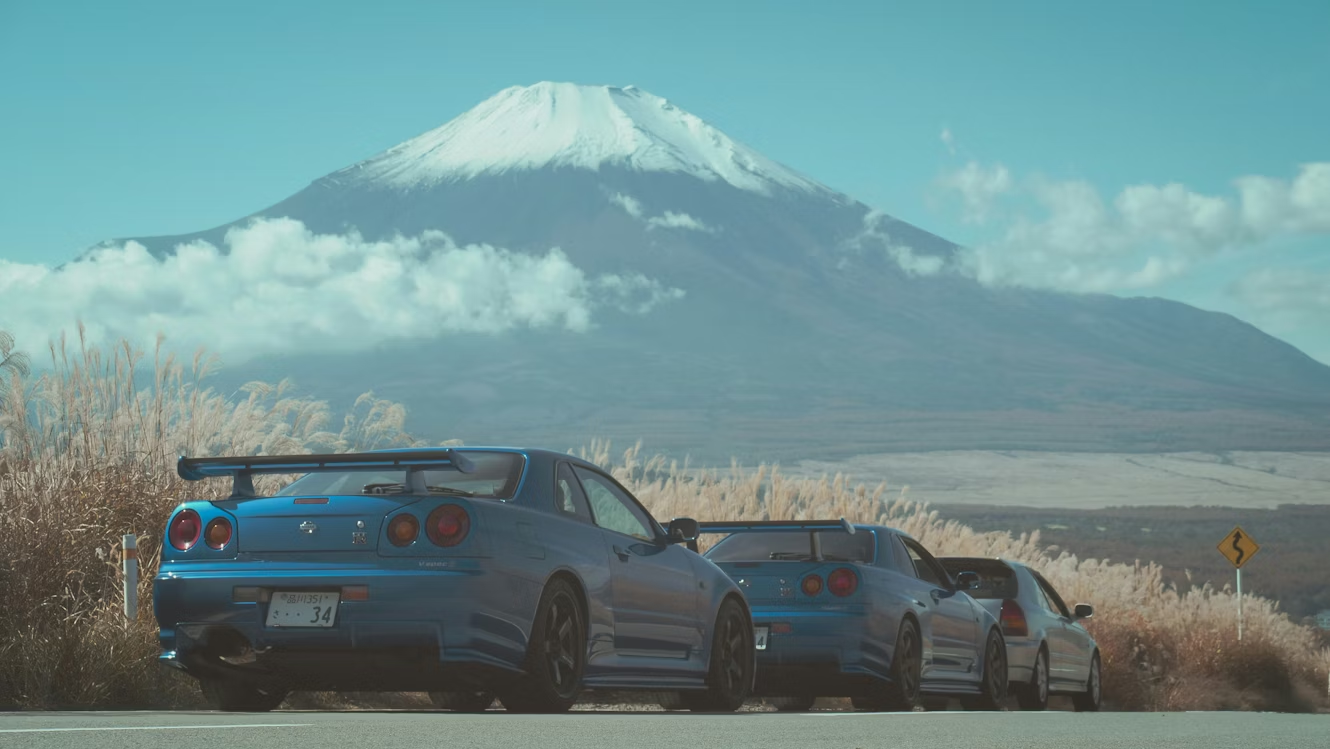
If you have a friend who loves cars, they’ve probably mentioned Japanese brands to you like Honda, Toyota, Nissan, Subaru, and Mazda. These makes have an almost cult-like following, but why is this? Why are they so popular? And why are so many people hooked on them instead of conventional Western brands?
The purpose of this post is to find out. We look at some of the reasons why Japanese cars have been wildly successful on the global market.
Incredible reliability
One of the main reasons Japanese cars have captured the public imagination is their legendary reliability. Many vehicles made by Toyota, Lexus and Nissan never quit. Instead, they continue to provide their owners with reliable service even beyond the 300,000-mile mark with basic maintenance. The reason people obsess over this is because it gives them peace of mind. They know that they’re not going to be breaking down all the time, which is a much more common problem with European and American car brands. They also have fewer repair bills and more freedom to simply enjoy driving on the road.
Higher resale values
Another significant perk of Japanese vehicles is their higher resale values. In this sense, they’re a little bit like Apple devices. They cling on to their value for longer and they depreciate less. A well-looked-after Toyota Corolla or Honda Civic can remain valuable for 10 years or more. Many owners report selling their cars for close to what they originally paid for them, even after five years of use. Again, the reason for this comes down to their reliability. Future owners know that maintenance requirements will be lower, so it makes buying one of these vehicles a smart financial choice.
Attention to detail
Many people assume that Japanese cars are mass-manufactured, but actually vehicle makers pay immense attention to detail to create the most precise and reliable vehicles on the planet. Most Japanese cars have overbuilt components. This means that they can outlast any abuse drivers throw at them.
Japanese production facilities also implement a process called kaizen, which means continuous improvement. This strategy ensures that every unit produced has improved precision and quality control, with later runs in any production cycle offering the best value for money. Japanese deliberately build many of their cars for them to last forever. Because they focus on real-world durability and not just laboratory testing, vehicles have extreme robustness, especially among the parts that make contact with the engine and the road.
Performance heritage and tuning potential
On top of all of this is the performance tuning potential. Many Japanese brands offer high-end cars with the option of swapping out various components to make them even more powerful or capable. For example, JDM already bought us the Toyota Supra, Nissan Skyline, Honda NSX and Mazda RX-7. What’s more, these cars are all tunable, allowing owners to replace their turbos, superchargers, tires, wheels, electrical systems, exhausts and gearboxes. Because of this, many of these cars can become even more powerful and capable with the manufacturers providing a solid base on which to build upon.
Incredibly, after proper tuning, some vehicles wind up with over a thousand horsepower. This is the same sort of performance that you might get from a million-dollar European sports car, but at a fraction of the cost.
Drift culture
Some people are also obsessed with Japanese cars because of drift culture. Japan’s car scene is built upon principles like perfectionism, craftsmanship, and respect. It also has a certain martial element in it which evolved out of the samurai tradition, which was replaced by Japan’s modern economy after the Second World War.
Because of this, many drivers in Japan engage in so-called mountain pass battles where they drift their vehicles professionally, displaying their expertise in handling and balance. This replicates more ancient elements in Japanese culture, like shogunism and shintoism. Ultimately, people from the West who love Japanese cars respect the culture of clean values and attention to detail. It is more about building a community than purely showing off speed.
The unique aesthetics of JDM imports
On top of this is the unique aesthetics of JDM imports. Japanese car manufacturers create vehicles that are quirkier and often more futuristic than their Western counterparts. Many examples exist, including the Honda Civic, which are one-of-a-kind. When it comes to performance vehicles, Japanese sports cars tend to be blockier and boxier than their European counterparts. However, the R32 and R33 Skylines are hidden gems for many auto enthusiasts, being available for a fraction of the price of equivalent models in Europe.
What’s more, many of these vehicles remain low-maintenance and age well. They’re made of the same parts as mainstream models, lower down the product hierarchy. Meaning that they can survive even the hardest driving and still thrive years later.
Fuel efficiency
Coming back down to Earth, many people love Japanese vehicles because of their fuel efficiency. The Prius was a good example. As one of the world’s first hybrid vehicles, it allowed drivers to go hundreds of miles on a single tank, as long as they charged up their batteries. In an era where fuel costs are rising and more people are concerned about the environment, fuel efficiency is becoming the lynchpin of Japan. The appeal of Japanese vehicles: more people want tiny urban runabouts made by the Asian island nation and Kei cars.
Nostalgia and media influence
Finally, many people are interested in Japanese cars because of the nostalgia surrounding them and the media influence. Games like Gran Turismo in the 1990s directed the public’s attention to the types of Japanese vehicles that were available. Most people in the Western world didn’t know that the country was capable of producing such exquisite vehicles. This then led to the creation of communities of like-minded, passionate people who loved tinkering on Japanese cars in their garages. Other media influence includes movies and anime cartoons and even YouTube videos, many of these romanticised Japanese vehicles, increasing their allure and influence.
Leave a Reply